18 Kentigern Gardens
The Cuckoo's Calling18 Kentigern Gardens is the Mayfair apartment building where Lula Landry lived and fell to her death. Initially presented as a guarded, prosperous residence, it becomes the central spatial puzzle of the investigation: its doors, security routines, adjoining flats and small traces of movement expose the gap between an apparently inaccessible building and the routes available to someone already inside.
Setting and appearance
The building stands on a sedate, affluent Mayfair street of high Victorian red-brick houses, stone detailing, white marble porticos and glossy black entrance doors. When Cormoran Strike and Robin Ellacott revisit the site, number 18 has returned to the restrained appearance of its neighbors; the police tape and crowds of journalists that once made it a spectacle are gone. The top-floor balcony from which Lula fell is about forty feet above the street, and the shallow balconies have little standing room. The building’s orderly, expensive exterior makes it look protected, but the investigation finds that appearance alone says little about who could enter or move through it.
The night Lula died, the street’s usual crowd of photographers had dispersed. Some had followed Lula’s car from Uzi; others had gathered because rapper Deeby Macc was expected to stay in the apartment below hers. Once it became clear that Macc would not arrive for some hours, the photographers left. The cold, snowy street was therefore empty when Lula fell. The opening image of the book, by contrast, shows the same street crowded with photographers, police and onlookers after her death: the building’s entrance, upper balcony and the tent covering the body become objects of public attention.
Entrances, security and routes
Number 18 has a keypad and a camera above its front door. Residents did not normally use the keypad: staff could recognize them on camera and release the entrance from the security desk. The keypad was intended for times when nobody was at the desk, while delivery workers and other visitors were generally admitted by staff. The flats had individual keys and alarm systems. These measures created layers of access, but they depended on human routines and on the assumption that someone was continuously watching the entrance.
That assumption fails during the interval central to the case. Security guard Derrick Wilson left the desk for roughly fifteen minutes because he urgently needed the bathroom. Strike focuses on the practical consequence: a person outside would not necessarily know Wilson had left, and the entrance was not transparent. Robin points out that an intruder would also need the door code; Strike replies that codes can become widely known if they are not changed regularly. Their discussion shifts the question from whether entry was theoretically possible to who could know the code, exploit the unattended desk, or avoid the entrance altogether.
The building’s internal layout widens the possibilities. A wooden door connects the main interior to the gym, pool and car park. From the gym, another door opens onto a marble stair leading down to an underground garage, where doors at intervals along the wall provide inner entrances to the houses on the street. The garage contains a line of expensive cars and is monitored by cameras whose dark housings point down from the upper walls. The arrangement suggests several routes between residences and the garage, as well as opportunities for concealment; the presence of cameras raises the further question of whether every relevant view had been monitored that night.
The night of Lula’s death
Wilson says that he was in the bathroom when he first heard a distant bang, which he later understood to be Lula’s fall. He then heard shouting and ran into the lobby, where Tansy Bestigui told him that Lula was dead and that a man had pushed her from her flat. Wilson went outside and found Lula in the road. He returned to the building, took the master key from the back room and went upstairs to search her apartment.
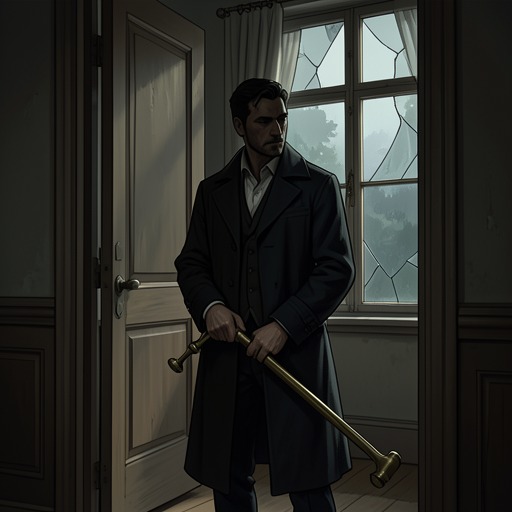
The search was shaped by Wilson’s belief that a man who knew the entry code had come in while he was away. He had previously heard Lula arguing with a man and thought that person might have pushed her. But the flat appeared empty. Its living-room windows stood wide open despite the freezing weather, and the lift remained on Lula’s floor. Wilson did not touch the windows; he went back downstairs and then returned outside, unwilling to leave Lula alone while waiting for the police.
The police search extended beyond Lula’s flat. Wilson took an officer back upstairs to inspect the apartment, the open windows and the lift, then opened the middle flat with the master key. That flat was dark; its alarm sounded as they entered, and the officer knocked over a large vase of roses in the hall. The search found the rooms empty and the windows closed and bolted. Later, when Strike asks Wilson to retrace his original search, Wilson remembers slipping on the stairs where there were drops of water. That small detail becomes important in the eventual reconstruction of the route from the middle flat to Lula’s door.
The investigation and the building’s hidden possibilities
At first, the possibility of an intruder arriving from the street appears difficult to reconcile with the building’s entrance, the guard’s absence and the short interval between Lula going inside and her fall. Strike considers another possibility: the killer may already have been in the building. In that case, a resident, security worker or person concealed inside could act without facing the same problem of entering and leaving through the front door. The apparently secure residence is thus not simply a barrier; it is a collection of adjoining spaces, service routes and moments when supervision lapses.
The Bestiguis’ flat becomes important because of its position and the uncertainty surrounding what happened there. Tansy said that she heard a man arguing with Lula before the fall, but the police tested her claim by having a man shout from Lula’s balcony while people in the Bestiguis’ first-floor flat listened. They could not hear him. Strike nevertheless remains unsettled by the Bestiguis’ precise positions at the moment Lula fell, noting that Tansy repeatedly maintained that her husband was in bed. The building’s architecture makes the dispute concrete: testimony about sounds and sightlines can be tested against the actual arrangement of floors and rooms, even when the results do not immediately settle what happened.
A further clue emerges when Strike reconstructs John Bristow’s movements. Strike believes Bristow hid in the middle flat at number 18, where he could watch the street, wait out the arrival of visitors and move between the flat and Lula’s apartment. The plan depends on the building’s routine and layout: Bristow could get in and out of the middle flat without setting off its alarm, and the police had not found him there during the initial search. Strike’s account connects that hidden position with the vase of roses, the water drops on the stairs and Wilson’s forgotten slip, turning separate details into a route through the building.
In Strike’s final reconstruction, Bristow carried white roses from the middle flat to Lula’s apartment. He had dried their stems, but not completely; water left on the stairs caused Wilson to slip later. The flowers also offered a means of getting Lula to open her door: she had been waiting for her brother, and, seeing the roses through the peephole, opened the door in expectation of his arrival. The middle flat, first encountered as an empty apartment in a hurried police search, becomes the concealed staging point that resolves how the killer could approach Lula without being seen entering the building.
Narrative significance
The building gives the investigation a physical form. Its public front suggests order and exclusion; its keypad, staff routines, individual alarms, inner garage doors and overlooked stairway details reveal a more complicated system of access. Every claim about who could enter, what could be heard and where someone might have gone must be measured against that system. The case turns not on a dramatic breach of security, but on the temporary absence of a guard and the use of an interior space that had been searched without its importance being understood.
The street outside the building also carries a sharp contrast between surveillance and absence. Photographers had gathered around Lula and the expected arrival of Deeby Macc, but they left before her death; later, cameras and onlookers flooded the street to record its aftermath. At the same time, the building’s own security camera and the numerous cameras in the underground garage promise observation without guaranteeing that the decisive movements were seen. Number 18 is therefore both a guarded home and a place where gaps in attention matter: an apparently secure address whose hidden routes and small material traces make a concealed approach possible.